MS-BenchA Condition-Stratified Multi-Speaker ASR Benchmark

32.72 hTotal duration
5Condition dimensions
2-14Speakers
21.87%Duration-weighted overlap
7Evaluated systems

Overview

Abstract

Multi-speaker automatic speech recognition (MSASR) has advanced rapidly with end-to-end speech large language models. However, existing benchmarks cover limited ranges of specific multi-speaker conditions and scenarios, making it difficult to reveal system limitations under diverse conditions and scenarios. We introduce MS-Bench, a condition-stratified benchmark for fine-grained MSASR evaluation. MS-Bench integrates both public and internal benchmarks and characterizes each recording along five dimensions: speaker number, overlap ratio, speaker similarity, speaker turn interval, and acoustic quality. We stratify these dimensions into condition ranges and construct MS-Bench with broad coverage of conditions, scenarios, languages, and recording devices. Evaluating representative commercial, open-source, and cascaded systems, we find that overlap affects both lexical recognition and speaker attribution, while other factors exhibit more task-specific effects on recognition, attribution, or temporal prediction. These results demonstrate that aggregate metrics alone obscure important MSASR failure modes and highlight the value of condition-stratified evaluation. MS-Bench aims to reveal condition-specific limitations of current MSASR systems and guide future improvements.
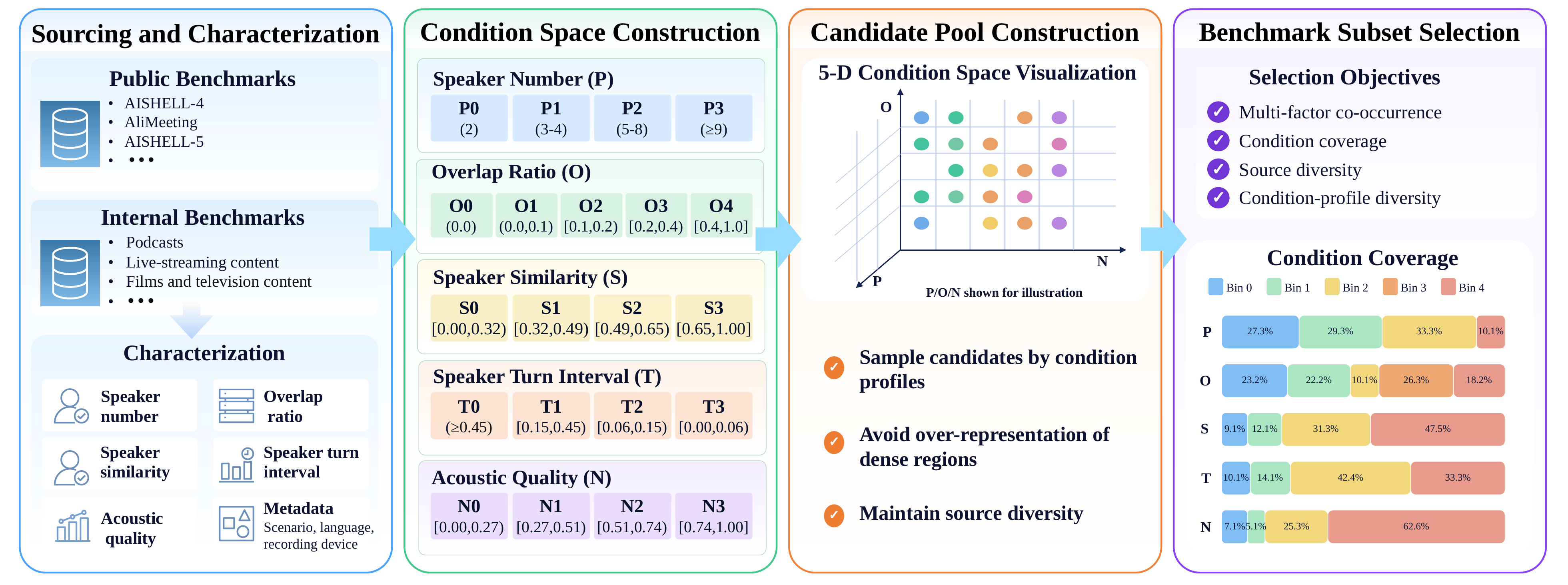
Construction pipeline

MS-Bench construction pipeline from data sourcing through characterization, condition space, candidate pool, and subset selection.
MS-Bench construction pipeline. Recordings from public and internal benchmarks are characterized along five condition dimensions and grouped into ranges. A candidate pool is built from these condition profiles to limit over-representation and preserve source diversity. The final subset is selected for condition coverage, multi-factor co-occurrence, condition-profile diversity, and source diversity.

Benchmark composition

Condition distributions

Note: Each range shows its recording count and percentage of the benchmark. Click a range to filter recordings in the Condition Explorer.

Loading condition distributions...
Condition definitions and ranges

Scenarios

Loading scenario description...

Languages

Loading language description...

Recording duration

Count-based distribution over complete recordings.

Loading duration distribution...

Condition explorer

Note: Select one range per condition. Recordings must match all selected ranges. Counts show matches with your current filters; unavailable ranges are disabled. Use Reset to clear the filters.

No active filters
Speaker number
Overlap ratio
Speaker similarity
Speaker turn interval
Acoustic quality
Preparing metadata...- / 99 recordings
Total duration
-
Median duration
-
Duration-weighted overlap
-
Languages
-
Settings
-

Overall performance

Note: Seven systems from the paper. Lower is better for every error metric. DER uses a 0.5-second collar; tcpWER uses a 5-second collar.

Accuracy across tasks. MOSS-Transcribe-Diarize-Pro has the lowest error on all four metrics. Similar diarization scores can still hide large transcription differences: Qwen3.8-Omni-Flash and pyannote+Qwen3-ASR have DERs of 17.97% and 17.35%, but cpWERs of 29.43% and 43.25%.

Accuracy and robustness. MOSS-Transcribe-Diarize and the cascaded system have no excluded inference units. MOSS-Transcribe-Diarize-Pro has 15 excluded units despite its lower error rates, so accuracy and output robustness should be read together.

Best and second-best values are marked by column.

Loading system results...

Metric and scoring protocol

DER: diarization error with a 0.5-second collar. cpWER: speaker-attributed transcription error under optimal speaker permutation. tcpWER: time-constrained cpWER with a 5-second collar. WER: speaker-agnostic lexical error.

Metrics use each system's scoreable inference units, so valid subsets may differ. Excluded units cannot be scored reliably. Soft-degradation units remain parseable and are retained.

Condition-wise analysis

Loading diagnostic findings...

Audio examples

Note: Choose a sample and compare the reference with two models. Click any transcript line to play from that point. Scroll within a transcript to browse freely; click a line or enable following to resume automatic scrolling.

Loading representative cases...